Category: Field Reports

  • FIELD REPORT #004

    FIELD REPORT #004

    The Spider She Already Knew

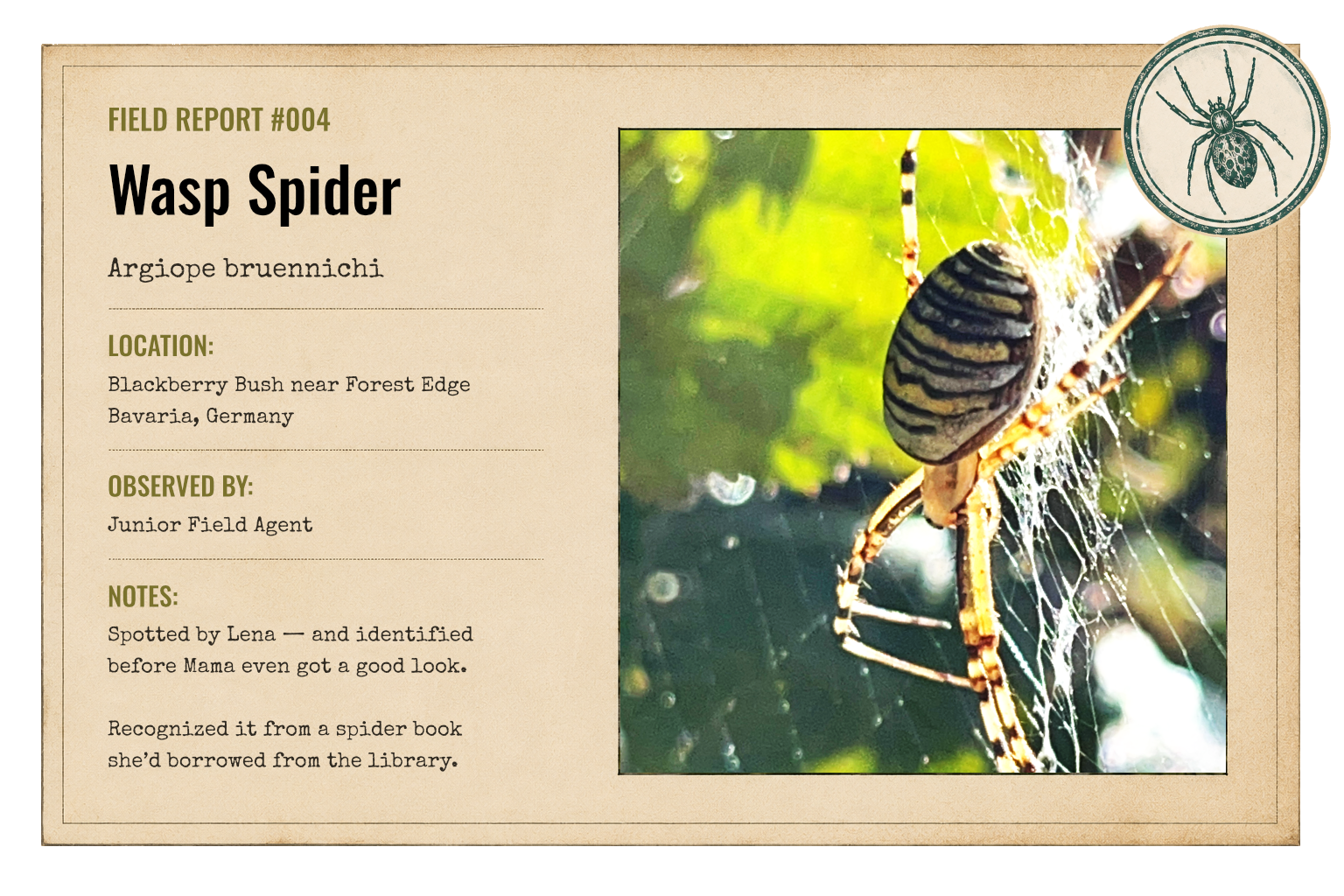
    Species: Wasp Spider · Argiope bruennichi
    Location: Sunny hillside near the forest edge · Bavaria, Germany
    Observed by: Junior Field Agent, Junior Field Agent #2 & Bureau Chief

    We know this hillside pretty well by now.

    It’s one of those places where slowing down and looking closely almost always pays off. The sunny slope is full of wild plants, and on previous patrols we’ve found so many true bugs here that it’s starting to feel like their preferred neighborhood.

    This time, we were walking a little farther up the path when Lena stopped at a large blackberry bush.

    There was a pretty impressive spider web.

    I was still trying to get a proper look at it when Lena had already made her call:

    “Wasp Spider!”

    I hadn’t even gotten as far as opening my identification app.

    She was right.

    Apparently, Someone Did Her Reading

    Lena had recently borrowed a book about spiders from the library.

    I’d seen her flipping through it, of course. What I hadn’t realized was exactly how much of it she’d quietly filed away for later.

    Because there, sitting in the sunshine on a blackberry bush, was a spider she’d previously only known from a book:

    A Wasp Spider (Argiope bruennichi).

    The adult females are difficult to forget once you’ve seen one. Their abdomen is boldly striped in yellow, black and white — giving them the decidedly un-spider-like name of Wasp Spider.

    And apparently making them recognizable enough for a six-year-old to identify one in a blackberry bush before her mother had worked out what she was looking at.

    Noted.

    A Very Good Place to Be a Bug

    Our Wasp Spider seemed perfectly at home on that sunny hillside.

    The species favors warm, open habitats with plenty of vegetation for its large orb webs. Grasshoppers are among the prey they can catch — and a sunny, insect-filled slope like this one provides plenty of hunting opportunities.

    Despite the dramatic warning-color appearance, the stripes are mostly impressive from our perspective. Wasp Spiders aren’t considered dangerous to people.

    We took our photos, had a proper look and left her exactly where she was.

    Another species for our growing list from this little hillside.

    And another reminder that bringing the Junior Field Agent along significantly increases the Bureau’s identification capabilities.


    FIELD NOTES

    📍 Sunny hillside just outside the forest edge

    🌿 Spotted on a large blackberry bush

    🕷️ First Wasp Spider recorded by the Bureau

    📚 Recognized by Lena, thanks to her library spider book

    Bureau status: Observed in the wild · Left undisturbed
  • FIELD REPORT #003

    FIELD REPORT #003

    This Woodlouse Is Supposed to Be Grey.

    Species: Common Rough Woodlouse · Porcellio scaber
    Location: Bug Bureau HQ garden · Bavaria, Germany
    Observed by: Junior Field Agent

    Sometimes a Field Report starts with a long walk, a promising patch of wildflowers and several pairs of eyes looking for something interesting.

    And sometimes Lena lifts a flower pot.

    Inside was a random collection of bark, branches, rocks and whatever the field agents had found on our last forest walk — underneath a woodlouse that looked perfectly ordinary in every way except one.

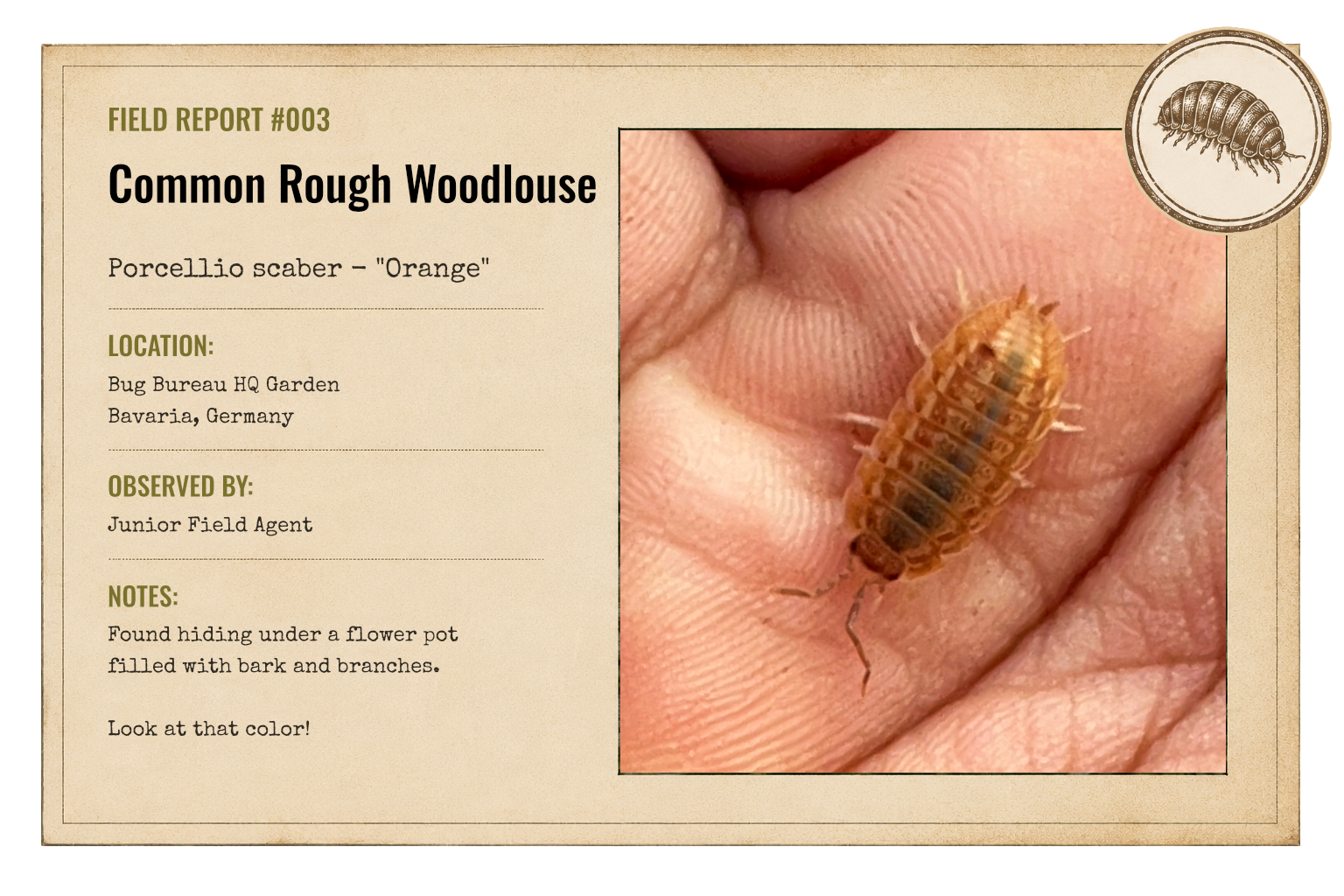
    It was orange.

    Not sort-of-brown. Not warm grey.

    Very definitely orange.

    Same Woodlouse. Different Outfit.

    At around a centimeter long, our orange visitor looked like a Common Rough Woodlouse (Porcellio scaber) — one of those species we normally wouldn’t think twice about finding in the garden.

    Except P. scaber is usually grey, brownish or mottled.

    This one apparently hadn’t received the memo.

    IOrange coloration can occur in Porcellio scaber, and orange morphs are well known among people who keep and breed isopods. But this one hadn’t come from a breeder or a pet shop.

    Lena had simply found her living in our garden.

    Which immediately raised another question:

    Was she the only one?

    And Then We Found More

    Naturally, we started looking.

    In the same general area, Lena found a much smaller woodlouse with muddled orange coloration. Then we found another tiny one that looked distinctly orange-ish too.

    One unusually colored woodlouse could have been just that.

    Several in the same little patch of garden?

    Now the Bureau was interested.

    And so an ordinary afternoon of looking under things acquired an official investigation:

    Project Orange. 🟠

    A Temporary Transfer to HQ

    We decided to keep the largest orange P. scaber at HQ for a short observation period.

    The plan isn’t to keep her permanently. In a month or two, she’ll go back to the garden where Lena found her.

    But there’s something we’d really like to know first.

    If she’s female — and if she had already mated before we found her — she may produce babies while she’s here.

    If that happens, we’ll be watching to see how many there are and how many of them are orange.

    Maybe nothing will happen at all.

    Maybe we’ll end up with a box full of perfectly ordinary grey baby woodlice.

    Or maybe our garden has its own little population of orange Porcellio scaber hiding underneath the flower pots.

    For now, we wait.

    Project Orange is officially underway. 🟠


    FIELD NOTES

    📍 Found under a flower pot at Bug Bureau HQ

    🟠 Adult Porcellio scaber with striking orange coloration

    🔎 Smaller orange-ish individuals found nearby

    🏠 Temporarily transferred to HQ for observation

    ⏳ Planned observation period: 1–2 months

    Bureau status: Project Orange · Return to garden planned


    WHAT WE’RE WATCHING

    Will she produce babies while she’s at HQ — and if she does, how many of them will be orange?

  • FIELD REPORT #002

    FIELD REPORT #002

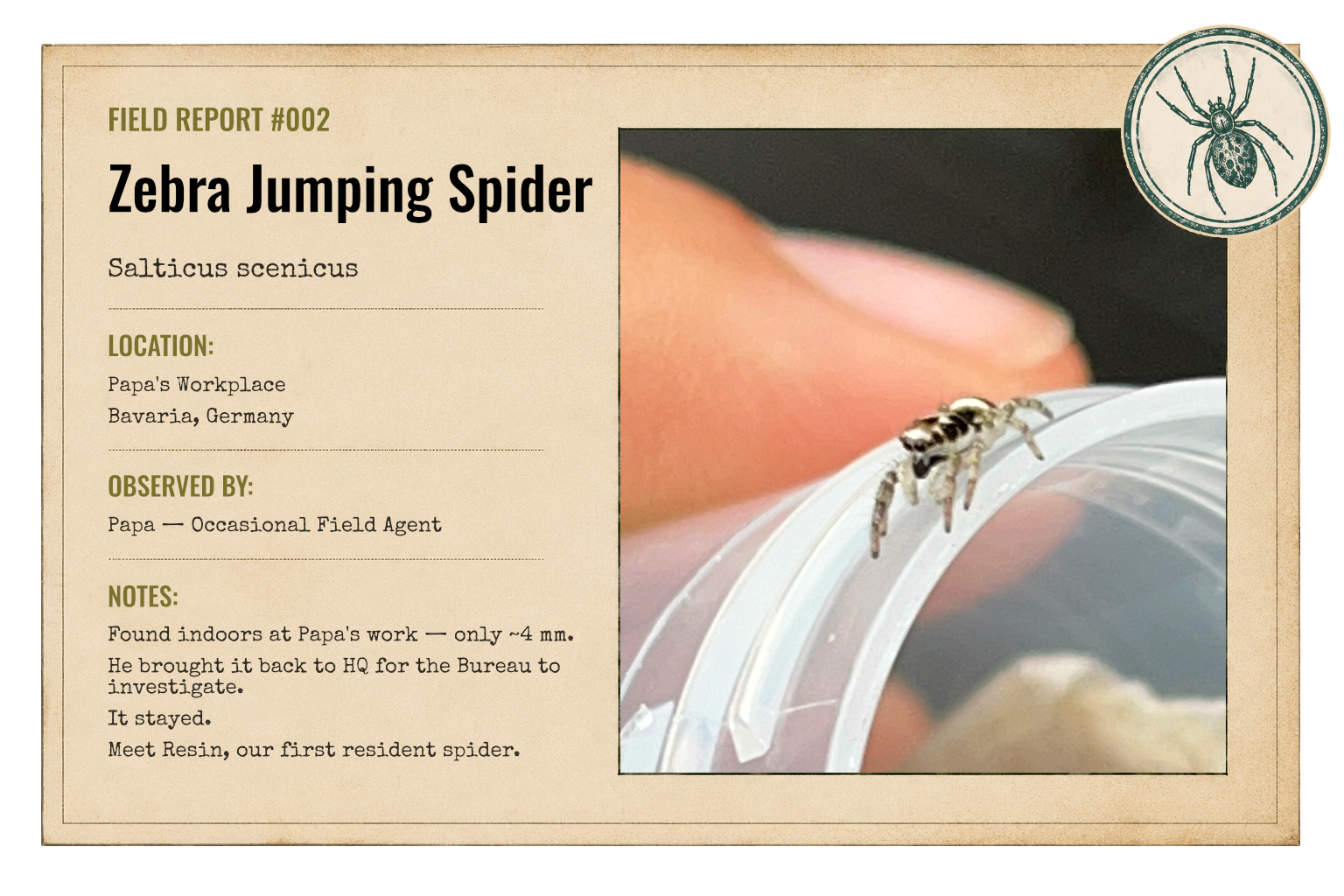
    Papa Brought Home a Spider

    Species: Zebra Jumping Spider · Salticus scenicus
    Location: Papa’s workplace · Bavaria, Germany
    Observed by: Papa · Occasional Field Agent

    THE STORY

    There was a time when Papa finding a spider indoors would have resulted in a very different message to Bug Bureau HQ.

    This time, he found a tiny jumping spider at work — and instead of getting someone to remove it, he contacted HQ.

    “There’s a jumping spider here!”

    Progress.

    The little spider had been found inside the building where Papa works. At only around 4 mm long, she was tiny, but the black-and-white markings made us suspect a Zebra Jumping Spider (Salticus scenicus), like the one that lived next to out garden water spigot for a while.

    And because Papa apparently takes his duties as Occasional Field Agent seriously now, he carefully brought her home for us to see.

    From workplace visitor to temporary HQ resident

    Zebra Jumping Spiders are commonly found around buildings, walls and other sunny surfaces. Unlike spiders that sit in a web waiting for dinner to arrive, jumping spiders actively hunt their prey.

    They also have remarkably good eyesight — something that becomes very obvious when you’re watching one.

    She watched us right back.

    We set up a small enclosure so we could observe her for a while, offered her tiny flies and gave her water droplets to drink.

    Two days later she built herself a little silk retreat.

    And a little while after, she molted.

    At that point, our temporary visitor was beginning to look suspiciously like a resident.

    Meet Resin

    Our Junior Field Agent and our Occasional Field Agent sat together and agreed on a name for our tiny new arrival:

    Resin.

    Since then, we’ve been getting our first proper look at what it’s like to care for a jumping spider — including figuring out exactly how small her food needs to be, watching her hunt and discovering just how much personality can fit into a spider only a few millimeters long.

    Papa has even been helping catch and prepare flies for her.

    Again: progress.

    So this Field Report has a slightly different ending from most.

    There was no immediate release at the end of our observation.

    Instead, Resin was officially transferred from the field to Bug Bureau HQ.

    And Bug Bureau unexpectedly acquired its first resident spider.


    FIELD NOTES

    📍 Found indoors at Papa’s workplace

    🕷️ Approx. 4 mm when she arrived at HQ

    🕸️ Built a silk retreat and molted 2-3 days after arriving

    Bureau status: Field find → Temporary HQ resident

  • FIELD REPORT #001

    FIELD REPORT #001

    Wild Carrot Patrol

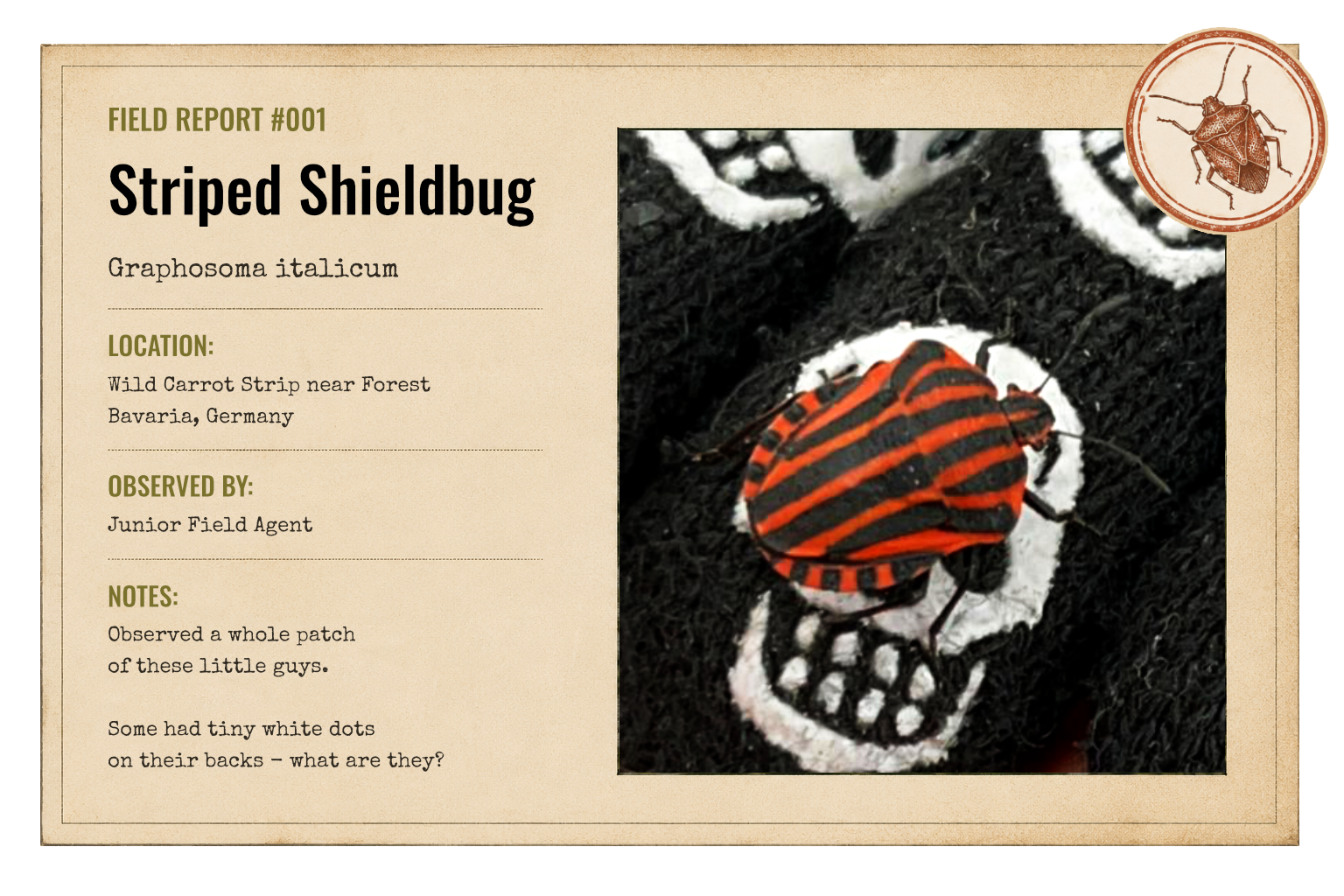
    Species: Striped Shieldbug (Graphosoma italicum)

    Location: A sunny hillside near the forest

    Some places become special for unexpected reasons.

    There’s a narrow strip of wild carrots growing on a sunny hillside along the path that leads into the forest. It’s not a spectacular destination. There’s no playground, no lake, and no hidden castle waiting at the end of the trail.

    And yet, it’s one of our family’s favorite places.

    Part of the reason is practical. The path is perfect for riding a tricycle, which makes the walk much more appealing for little legs.

    The other reason has six legs.

    The wild carrot patch is home to countless Striped Shieldbugs (Graphosoma italicum).

    Every summer, the plants seem to transform into tiny apartment buildings covered with red-and-black residents. No matter how often we visit, there always seem to be more of them. Some are climbing flower heads, some are hiding among the stems, and others are gathered together as if they’re having tiny neighborhood meetings.

    But the Striped Shieldbugs aren’t the only residents.

    During our very first walk there this year, we spotted four different bug species within this relatively small patch of vegetation.

    Alongside the Striped Shieldbugs (Graphosoma italicum), we found Purple Fruit Bugs, Northern Fruit Bugs, and Red-legged Shieldbugs.

    That immediately made us wonder what makes this place so special.

    The answer is probably hidden in the habitat itself. The hillside receives plenty of sunshine, and the dense stands of wild carrots provide food, shelter, and countless tiny observation platforms for insects.

    Whatever the reason, the bugs seem to agree that this is the place to be. And we are excited to have found this bug-tastic place.

    After a short while, the Striped Shieldbugs really became the stars of the show.

    Both kids fell in love with them..

    Unlike many insects that disappear the moment they’re discovered, these little bugs often stay surprisingly calm. They rarely fly away when Lena gently lets them crawl onto her hand.

    Those quiet moments have become some of our favorites.

    Watching an insect closely changes everything.

    The bright warning colors become more impressive. The antennae suddenly seem much longer than expected. Tiny details begin to appear. Personalities almost start to emerge.

    And that’s exactly why Lena decided to collect wild carrot seeds from the area.

    Her plan?

    To create a Striped Shieldbug neighborhood in our own garden.

    The seeds have already been planted, and now we’re waiting to see whether our future insect corner will become as popular as the hillside patch.

    During one of our recent visits, we noticed something we still haven’t solved.

    Some of the bugs were carrying tiny white dots attached to their backs.

    Parasites? Eggs? Mites? We’re still investigating.

    Sometimes, the best part of a field report isn’t finding an answer.

    It’s discovering a new question.

    We’ll definitely be returning to our little Wild Carrot Patrol station soon.

    After all, we still have a mystery to solve.

    FIELD NOTES

    📍 Sunny hillside near the forest path

    🪲 Four bug species observed

    🌿 Dominant plant: wild carrot

    Question for fellow insect enthusiasts:

    Have you ever noticed small white dots on Striped Shieldbugs? We’d love to hear your ideas.