
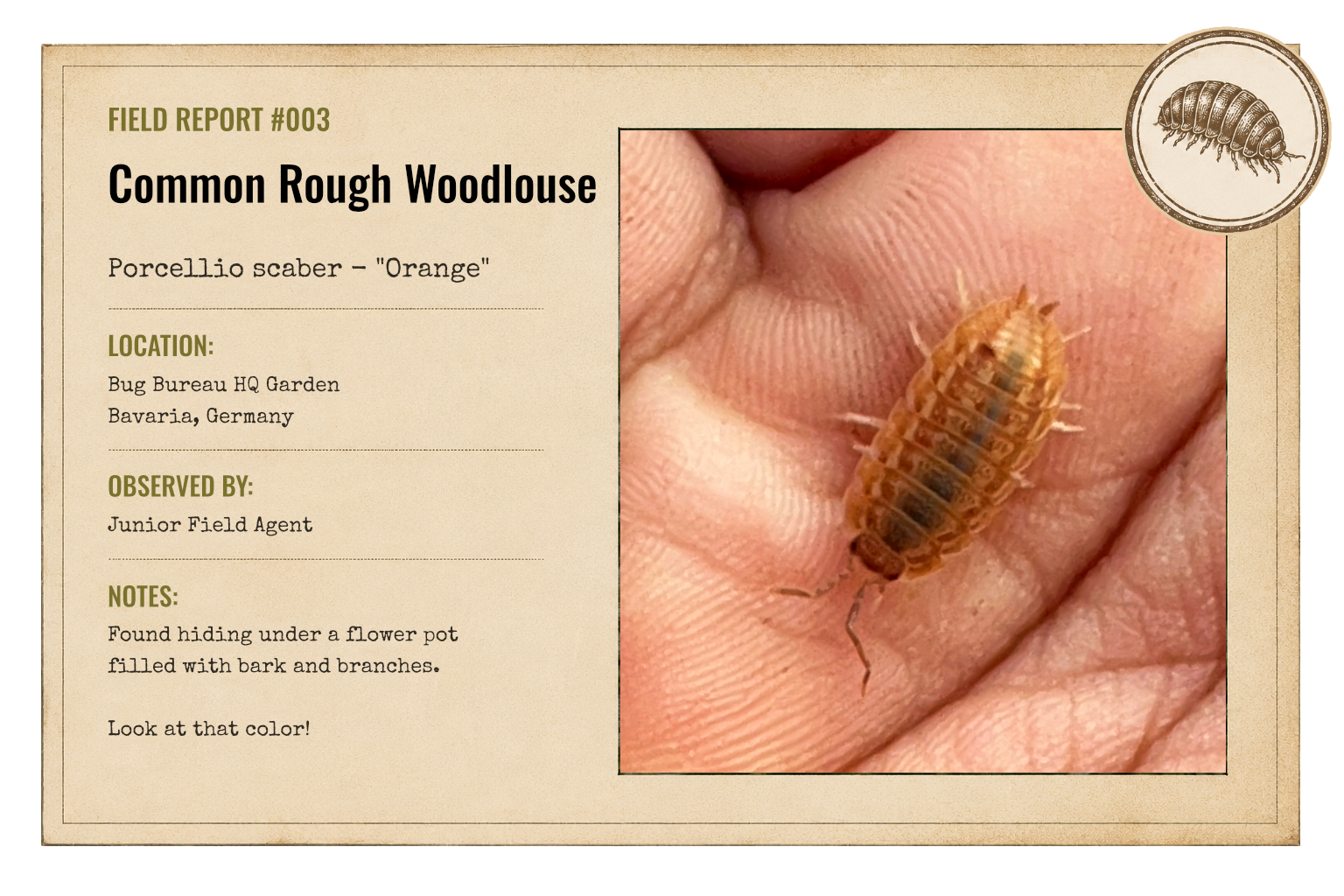
This Woodlouse Is Supposed to Be Grey.
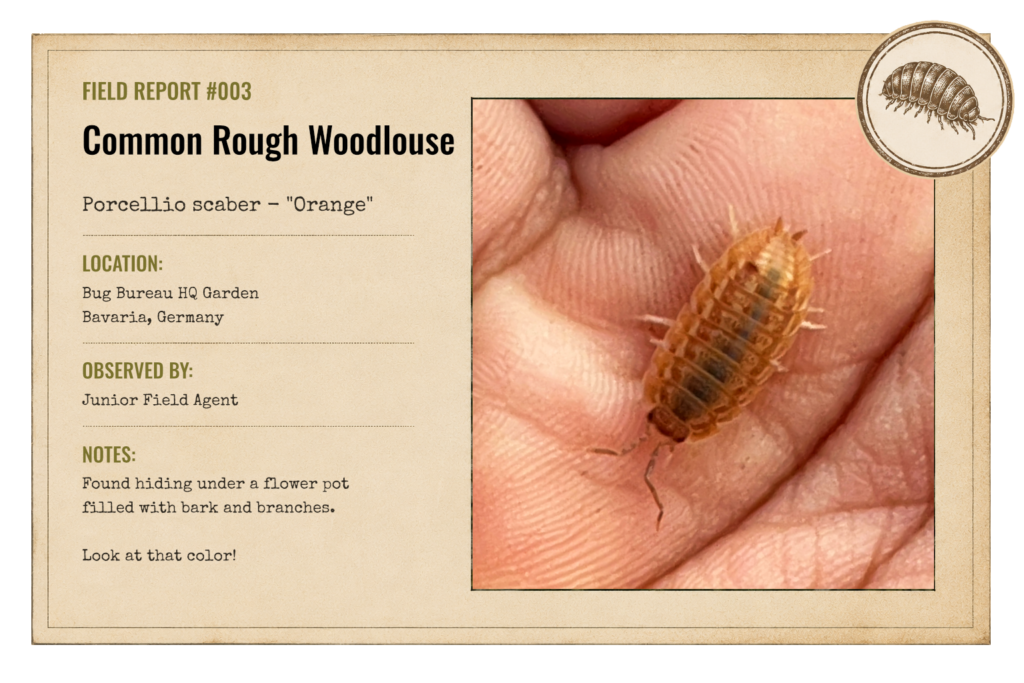
Species: Common Rough Woodlouse · Porcellio scaber
Location: Bug Bureau HQ garden · Bavaria, Germany
Observed by: Junior Field Agent
Sometimes a Field Report starts with a long walk, a promising patch of wildflowers and several pairs of eyes looking for something interesting.
And sometimes Lena lifts a flower pot.
Inside was a random collection of bark, branches, rocks and whatever the field agents had found on our last forest walk — underneath a woodlouse that looked perfectly ordinary in every way except one.
It was orange.
Not sort-of-brown. Not warm grey.
Very definitely orange.
Same Woodlouse. Different Outfit.
At around a centimeter long, our orange visitor looked like a Common Rough Woodlouse (Porcellio scaber) — one of those species we normally wouldn’t think twice about finding in the garden.
Except P. scaber is usually grey, brownish or mottled.
This one apparently hadn’t received the memo.
IOrange coloration can occur in Porcellio scaber, and orange morphs are well known among people who keep and breed isopods. But this one hadn’t come from a breeder or a pet shop.
Lena had simply found her living in our garden.
Which immediately raised another question:
Was she the only one?
And Then We Found More
Naturally, we started looking.
In the same general area, Lena found a much smaller woodlouse with muddled orange coloration. Then we found another tiny one that looked distinctly orange-ish too.
One unusually colored woodlouse could have been just that.
Several in the same little patch of garden?
Now the Bureau was interested.
And so an ordinary afternoon of looking under things acquired an official investigation:
Project Orange. 🟠
A Temporary Transfer to HQ
We decided to keep the largest orange P. scaber at HQ for a short observation period.
The plan isn’t to keep her permanently. In a month or two, she’ll go back to the garden where Lena found her.
But there’s something we’d really like to know first.
If she’s female — and if she had already mated before we found her — she may produce babies while she’s here.
If that happens, we’ll be watching to see how many there are and how many of them are orange.
Maybe nothing will happen at all.
Maybe we’ll end up with a box full of perfectly ordinary grey baby woodlice.
Or maybe our garden has its own little population of orange Porcellio scaber hiding underneath the flower pots.
For now, we wait.
Project Orange is officially underway. 🟠
FIELD NOTES
📍 Found under a flower pot at Bug Bureau HQ
🟠 Adult Porcellio scaber with striking orange coloration
🔎 Smaller orange-ish individuals found nearby
🏠 Temporarily transferred to HQ for observation
⏳ Planned observation period: 1–2 months
Bureau status: Project Orange · Return to garden planned
WHAT WE’RE WATCHING
Will she produce babies while she’s at HQ — and if she does, how many of them will be orange?
Leave a Reply